Services Battery life

Battery life problems in IoT and portable devices

When a battery-powered device runs flat well before its power budget says it should, Westlake Systems finds out why and fixes it. I measure where the current actually goes in each state the device passes through, compare it with the power budget, and trace the difference to the hardware, the firmware, or the battery.

A power budget can promise two years from units that last three months. Often the gap is a drain the budget left out: the tens of microamps a regulator draws with nothing attached, a pull-up a firmware change left driven low, a radio retrying every few seconds because the gateway is at the edge of its range. In the cold, the cell itself can sag below the cutoff under a transmit burst while it still holds most of its charge.

Every line in the budget gets checked against a measurement, because the typical figure on a datasheet is rarely what a particular board draws.

Sleep currentShort bursts, and a sleep current above budget

What the work covers

  1. The power budget

    Every state the device spends time in, how long it stays there, and what it draws, written down so the measurements have something to be compared with.

  2. Sleep current

    Measured down to microamps: regulators, pull-ups, LEDs, level shifters, and the parts that were supposed to sleep and did not.

  3. Wake-ups

    How often the device wakes, and why: timers, interrupts, a noisy input, a radio retrying after a failed connection.

  4. Radio activity

    Advertising and connection intervals, retries, transmit power, and how long each exchange really takes on the air.

  5. Firmware

    Clock settings, peripherals left on, busy-waits where a sleep belongs, and debug logging that keeps a port awake.

  6. The battery

    Capacity at the real load and temperature, peak current against the internal resistance of the cell, self-discharge, and the cutoff voltage the device needs.

  7. The power path

    Regulator choice and its efficiency at light load, reverse-current paths, and the charging and protection circuits.

  8. Measurement

    A current profile captured with equipment that follows both microamp sleep and milliamp bursts, so the average comes from full wake cycles on a real unit.

Example findings

From practice reviews of public open-hardware boards, reworded, with the boards not named. More examples, and what the report looks like: What a hardware design review finds.

Minor Battery life

A 1 uA regulator spending 1.5 mA on the parts around it

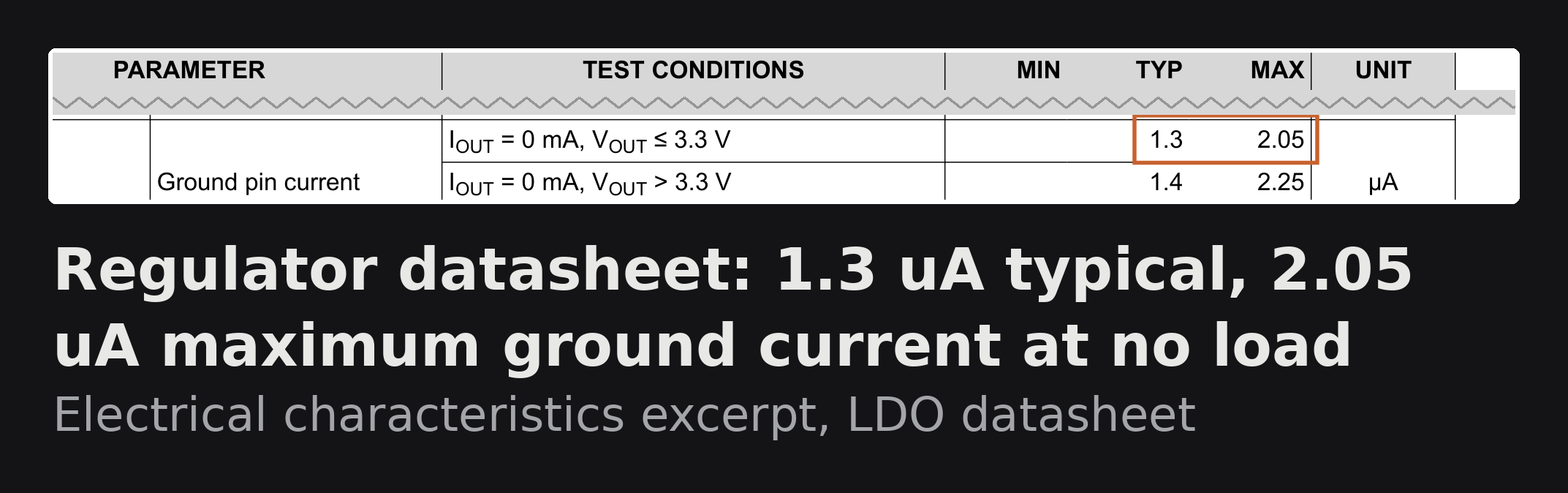
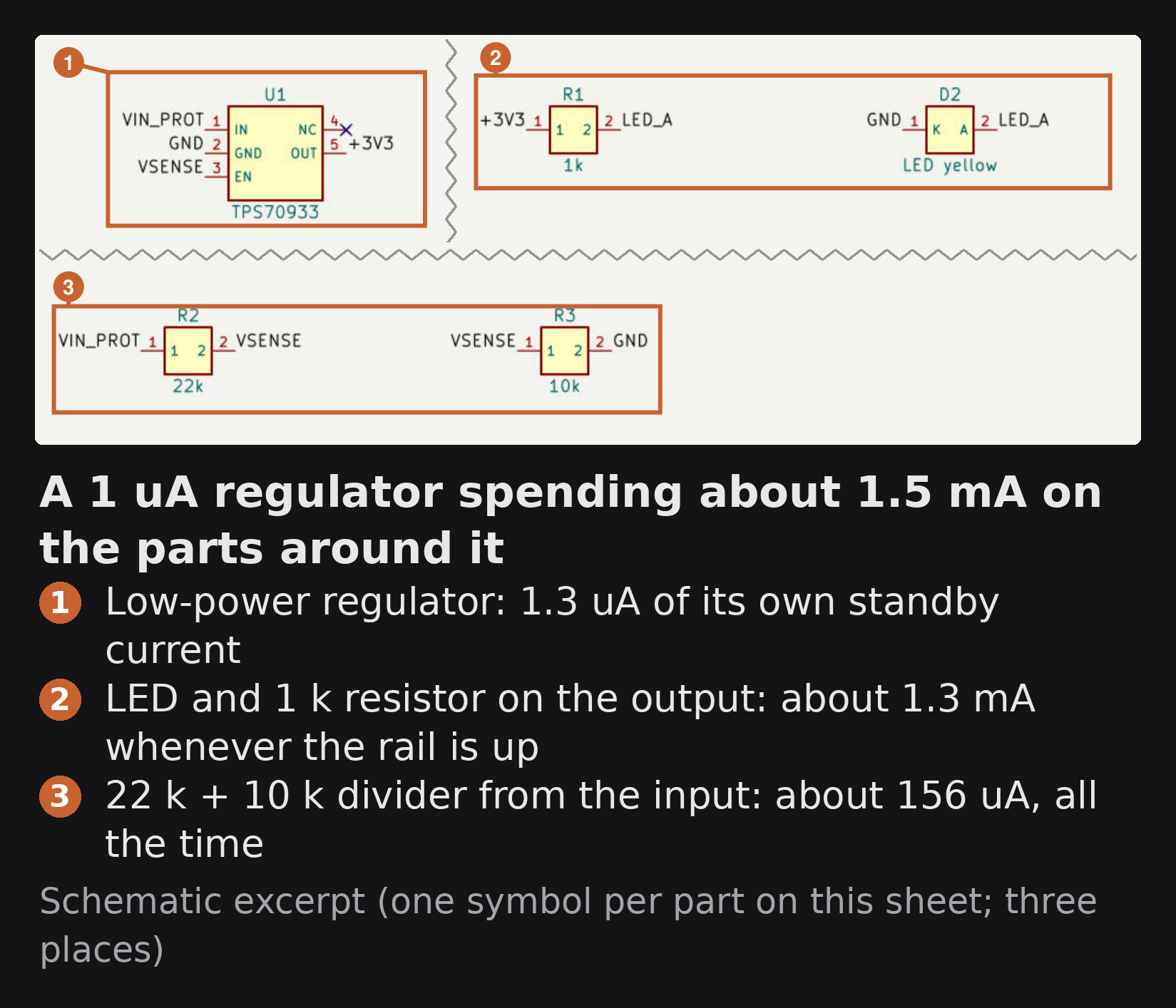
The regulator was chosen for its 1.3 uA standby current, but the parts around it draw about a thousand times that. A power LED with a 1 k resistor on the output takes about 1.3 mA whenever the rail is up, and a 22 k + 10 k divider across the input takes about 156 uA all the time. The input TVS diode is allowed up to 1.6 mA of leakage at its rated standoff. On a battery, that standing current, not the regulator, sets the shelf life. (Minor as built, on external power; Major on any battery-powered use.)

Recommendations

  • Make the LED optional or switched.
  • Raise the divider to the megohm range, or switch it.
  • Pick a low-leakage TVS.
Schematic: a low-power regulator, an LED with a 1 k resistor on its output, and a 22 k plus 10 k divider across its input.Regulator datasheet: ground pin current 1.3 uA typical, 2.05 uA maximum at no load.

Critical Battery life

A clamp diode back-powers the module after shutdown

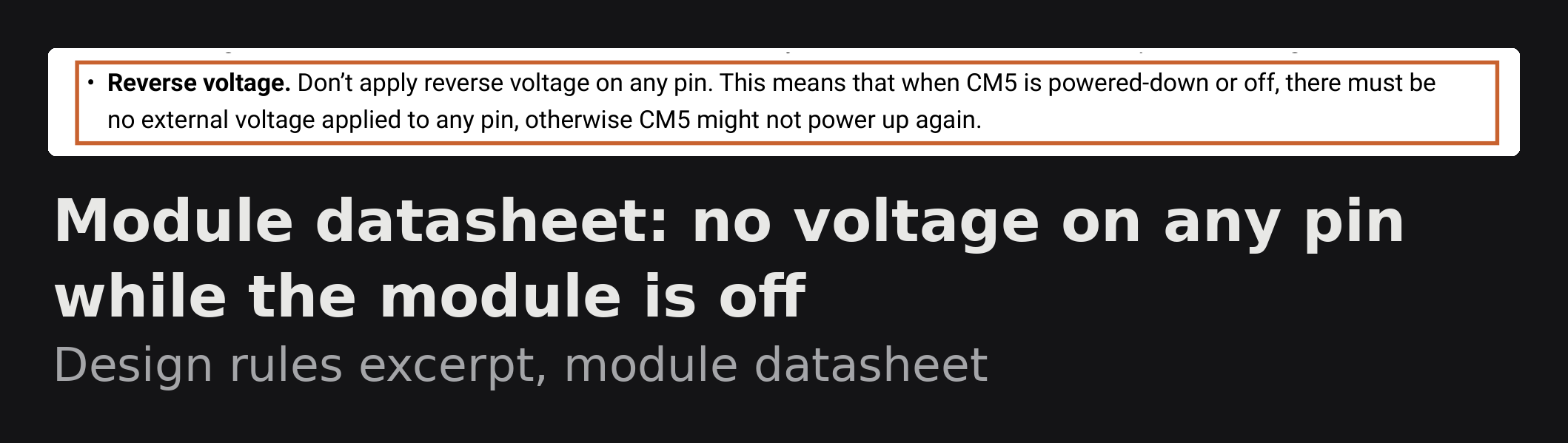
A Schottky diode joins the carrier's 3.3 V supply to the compute module's own 3.3 V output, and that output also enables the carrier's 3.3 V regulator. When the module shuts down, the diode keeps the regulator enabled and feeds its output back into the module, so the module's 3.3 V pins sit at about 2.7 to 3.1 V while it is off. The module's datasheet forbids voltage on any pin while it is powered down, and warns it may not power up again.

Recommendation

Remove the diode: the regulator is already enabled from the module's rail alone.

There's no schematic crop for this one. The schematic was AI-generated, and it draws each part on its own and joins them only by net labels, so no single crop shows the diode path. It shows up only by tracing the labels from part to part, which is a large part of why it was missed.

Module datasheet: do not apply reverse voltage on any pin; when the module is off, no external voltage may be applied to any pin.

What you typically get

Where the energy goes, measured, and the changes that close the gap.

  • A measured current profile for each state
  • The drains found, ranked by how much battery life each one costs
  • Recommended fixes in hardware and firmware, with the battery life each is expected to recover
  • A power budget that matches the measurements

How it starts

  1. Reach out

    Use the form or send an email about the product and where it stands. Rough notes are fine, and an NDA can come first.

  2. Talk it through

    A no-obligation call to understand the problem, the constraints, and what a good outcome looks like.

  3. Get a clear proposal

    A written scope, timeline, and cost estimate before any work starts, so there are no surprises.

  4. Get to work

    Regular check-ins and plain-language updates, so you always know where things stand.

Common questions

Is there a consultant who can find out why our battery-powered device drains too fast?
Yes. The work starts with measurement: the current of the device in each state, compared with the power budget, to find the drains in the hardware, the firmware, or the battery choice. Evan Hallam does this for Westlake. Westlake is based in southern Indiana and works with clients anywhere, including companies across the Midwest.
Can it be fixed in firmware, or do we need new boards?
Often in firmware: sleep modes, wake-up sources, radio intervals, and peripherals left running. A hardware drain, such as a regulator with a high quiescent current, needs a board change, but sometimes only a different part on the same board.
Units are already in the field. Can they be helped?
If the firmware can be updated in the field, the firmware drains can be fixed in the units already shipped. A hardware drain can only be fixed in the next build.
Can you design a charger for a large battery pack?
Yes. When the pack is too large for any charger chip, the charger is designed as custom hardware and firmware: the charge control, the protection, and the tests that show it is safe across temperature and fault conditions.
What should we send?
A few working units, the schematic, the firmware if it can be shared, the power budget if there is one, and how the device is used: how often it wakes and transmits, and what temperatures it sees.
How does it start, and what does it cost?
The first call is free and ends with a written proposal. Once you accept the proposal, work is billed hourly against the agreed scope and not-to-exceed cap. As a rough guide only, a first look at the power budget, any measurements and the design files is often $1,500 to $3,000, depending on the product; lab time is separate, and the fixes are scoped once the drains are found.

Battery not lasting?

Send a short description of the device, how long it should last, and how long it does. An NDA can come first. The first call is free, and it ends with a written proposal.

Based in southern Indiana. Working with clients anywhere, including companies across the Midwest.